How should you dress for a wedding as a guest?
 By Maxime Coste•
July 2, 2026•
8 min read
By Maxime Coste•
July 2, 2026•
8 min read
As a wedding guest, a man wears a suit in navy, light grey or beige depending on the season and the venue, a light long-sleeved shirt, leather shoes, and a tie if the ceremony is formal. Two colours stay off-limits: white, which belongs to the couple, and head-to-toe black in daytime. Invitation in hand and still unsure what to put on? This guide covers the rest: dress code, budget, fabrics, accessories and the mistakes that show up in every photo.
The short version
The guest outfit in five points:
- Reread the invitation. The dress code it names (cocktail, formal, rustic) decides most of what you wear.
- Buying a single suit? Choose navy. It works everywhere, from the town hall to the château, and earns its keep long after the wedding.
- Cool wool in spring, linen above 25°C (77°F), flannel in winter.
- Polished leather shoes, a matching belt, a pressed shirt. Those are the three things other guests notice first.
- Never white, never ivory, never all-black in daylight.
Decode the dress code before you open the wardrobe
"Cocktail attire" calls for a dark or softly coloured suit, tie optional. "Formal": dark suit, tie, black or very dark brown shoes. "Rustic" or "boho": light suit, soft fabrics, open collar allowed. These conventions are not arbitrary. Western dress codes have ranked menswear from lounge suit to black tie since the nineteenth century, so it pays to use that grammar rather than fight it.
And when the invitation names no code at all? Three clues speak. The venue first (château, town hall, beach, converted barn), then the time (a 3pm ceremony leans lighter than a 7pm cocktail), then the theme the couple chose. An outdoor summer wedding always pulls the outfit towards light and airy. When in doubt, ask the couple or another guest. Nobody has ever taken it badly, and you avoid being the only man in a three-piece suit at a garden-party theme.
Which suit should a guest choose?
The suit is the default answer for a wedding guest. Three calls to make: colour, fabric, budget.
What colour suit works for a guest?
Black is the classic trap. In daytime it reads like a funeral and hardens the face in photos. Navy is the guest colour by definition: elegant anywhere, easy to pair, and it moves straight to the office afterwards. Light grey shines in spring, especially with a coloured tie. Beige and sand tones do well in summer. Sage green and terracotta, sharper picks, signal real personal style at a countryside ceremony. Think about your partner too: a woman often coordinates her dress months ahead, and a few minutes of talking spares you the accidentally matching couple.
For the garment itself (shoulders, length, slim or straight cut), our guide on how to choose a suit covers every checkpoint. Remember the main thing: a jacket with the right shoulder width can be altered everywhere else, never the reverse.
Which fabric and budget for each season?
Cool wool, around 240 g/m², carries spring and autumn. Once the thermometer passes 25°C (77°F), switch to cotton or linen, a breathable, moisture-wicking fibre that keeps you cool in summer, and a linen suit gently creased by the end of the night has never shocked anyone in a July garden. In winter, wool flannel keeps you warm without bulking up the silhouette: wool fibre traps close to 80% air in its own volume, which is where its insulation comes from.
On price, budget 150 to 300 euros for a decent off-the-rack suit, 500 to 800 for made-to-measure, more for full bespoke from a tailor. Big labels guarantee nothing, the right fit does. Add 20 to 40 euros at the tailor's for the hem, waist and sleeves. It is the most profitable line in the whole outfit: a mid-range suit, well altered, beats an expensive one that fits badly.
Two-piece or three-piece with a waistcoat?
A three-piece suit pairs jacket and trousers with a matching waistcoat. As a best man it is almost a uniform: the waistcoat sets you apart from the other guests and lets you drop the jacket at dinner without breaking the look. As an ordinary guest, save the three-piece for formal or winter ceremonies. A relaxed wedding carries that solemnity badly, and you end up looking like you walked out of a board meeting.
The two-piece stays the guest standard, but the waistcoat has a quiet advantage. It hides a gaping shirt and holds the silhouette once the jacket comes off, which always happens before midnight.
No suit required? The blazer and trousers duo
For a relaxed wedding, a small town-hall ceremony or a next-day brunch, separates do the job well: navy or ecru blazer, flannel trousers or smart chinos, a pressed shirt. The look feels less solemn than a suit while sitting clearly above the everyday. It is also a good compromise when you never wear a suit and want to stay yourself.
The rule that saves you: every piece has to be flawless on its own. A blazer that puckers or chinos with bagged knees get noticed ten times more on a wedding day than the rest of the year. Comfort matters as much as style. Twelve hours standing, sitting and dancing takes some planning.
Shirt and shoes: the two non-negotiables
The white shirt stays the natural partner of the guest suit: it brightens the face and leaves the colour to the suit and accessories. Light blue as an alternative, fine stripes at a push. Long sleeves in every case, even in high summer, since a short-sleeved shirt under a jacket shows instantly at the wrists. And skip the black shirt, with a dark or a light suit alike.
On the feet, leather: derbies, oxfords or loafers, brown with light suits, black or dark brown with dark ones. Shined the night before, soles checked, and comfortable from the day you buy them, because a wedding is no time to break in a new pair. Sneakers, however spotless, stay a risk: keep them for the dance floor if the couple set that tone. High socks, plain or a discreet pattern, never sports socks.
Accessories: where the guest scores points
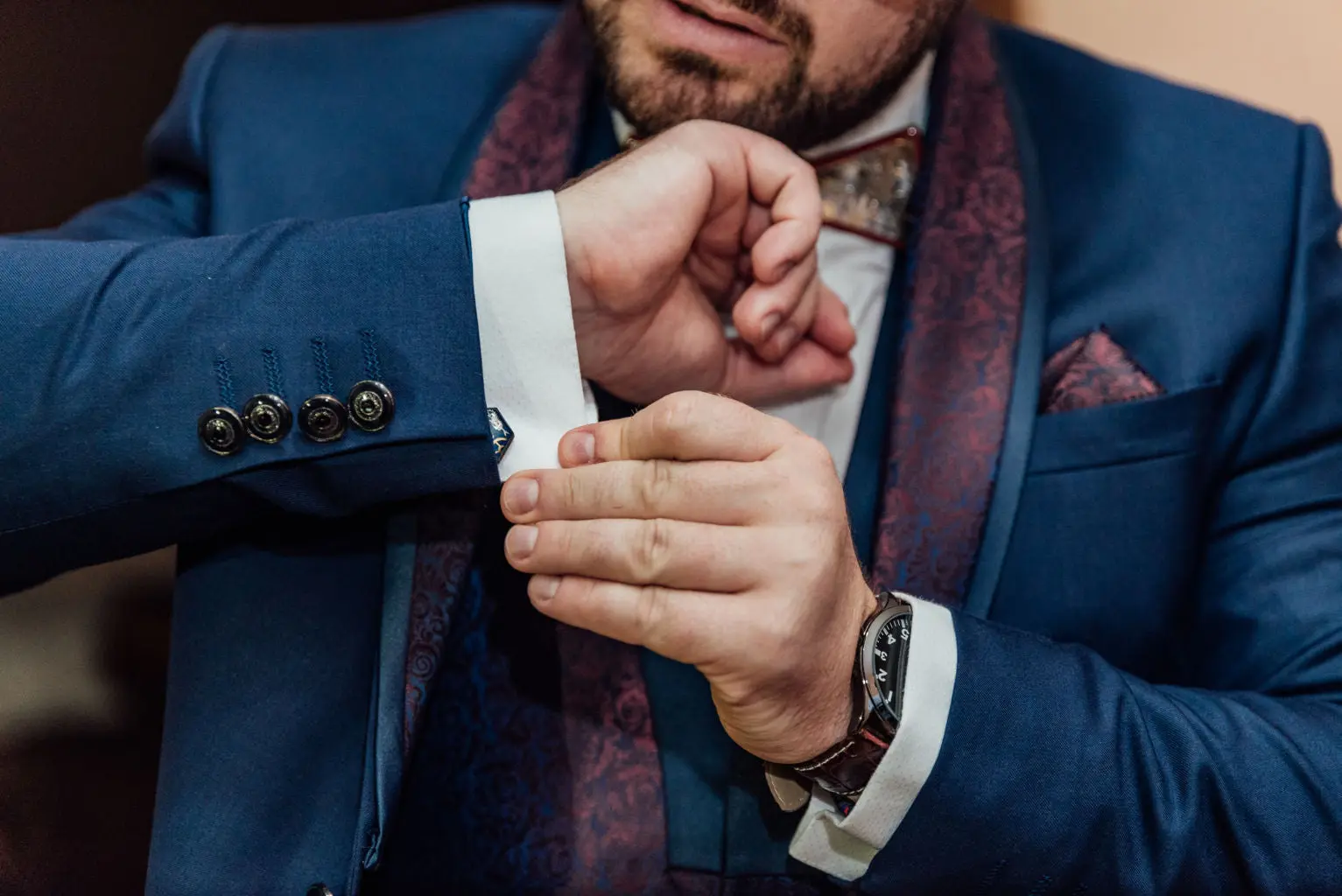
A matte silk or grenadine tie, one shade darker or brighter than the suit. A pocket square that talks to the tie without copying it. A leather belt matched to the shoes. The right watch for the outfit: slim case, leather strap, never a sports chronograph at a formal ceremony. A floral boutonnière if the theme allows and the couple suggest it. A bow tie holds its own too, as long as you own it for twelve straight hours, and braces stand in nicely for a belt under a waistcoat.
One remarkable accessory at a time. The flamboyant pocket square OR the coloured socks OR the patterned tie. Piling them up turns the elegant guest into a circus act, and the photographer's lens loves that, for the wrong reasons.
The recap, outfit by outfit
Each kind of ceremony has its own instincts. For a beach or destination wedding, for instance, an open-collar linen shirt stands in gracefully for the shirt-and-tie pair. The table below sums up the styles that work, occasion by occasion.
| Type of wedding | Recommended outfit | Avoid |
|---|---|---|
| Formal / religious ceremony | Navy or dark grey suit, white shirt, tie, black shoes | Light suit, open collar |
| City cocktail | Dark or light grey suit, tie optional, pocket square | Jeans, sneakers |
| Rustic / boho | Light linen or cotton suit, open collar, loafers | All black, heavy cloth |
| Beach / abroad | Light trousers, linen shirt, loafers or smart espadrilles | Shorts, slides |
| Relaxed town hall | Blazer, smart chinos, shirt, derbies | Fancy tracksuit, t-shirt |
| Winter wedding | Flannel suit, waistcoat, double-breasted wool coat, plain scarf | Puffer over a suit, linen |
The mistakes that show in every photo
White and ivory first: those colours belong to the couple, and the bride's dress takes no competition, not even from a man. A woman has always known it, a man sometimes forgets with white trousers under a navy blazer. Next come the too-small suit inherited from your self of ten years ago, the shirt pulling between buttons, and the tie loosened the moment you leave the church while the group photos are still to come.
Last point, perspiration. A wedding runs twelve hours, sometimes more. An invisible undershirt, a second shirt in the car for the far-sighted, a jacket in a natural fibre that breathes: a kilo of wool can hold about 150 g of water, roughly 15% of its weight, where polyester forgives nothing. The guest at ease at midnight is the one who kitted up at noon, and he is the one who still looks presentable in the 11pm photo.
Frequently asked questions
Can you wear a black suit to a wedding?
Only if the dress code is very formal or the reception is in the evening. In daytime, black reads like a funeral: a navy, a light grey or a beige suit feels right straight away.
Is a suit mandatory for a guest?
No, unless the invitation says so. A blazer with smart chinos, a pressed shirt and leather shoes are plenty for a relaxed or countryside wedding.
How should a man dress for a winter wedding?
Go for a flannel or heavy-wool suit, a matching waistcoat for warmth, a dark wool coat over it and a plain scarf. The three-piece earns its place here: it insulates and keeps the outfit complete once the coat is checked in.
How does the best man dress?
The best man sits a notch above the guests, often in a three-piece or a colour coordinated with the groom. The one absolute rule: never be better dressed than the groom himself. You accompany, you do not upstage.
Which colours should you avoid at a wedding?
White and ivory, reserved for the couple, all-black in daytime, and any loud print that catches the photographer's lens for the wrong reasons.
Do you have to wear a tie to a wedding?
For a religious ceremony or a formal dress code, yes. For a countryside or summer wedding, a neat open collar works very well, perhaps lifted by a pocket square to keep a dressed-up touch.
Maxime Coste writes about menswear, well-cut basics and dressing well without overspending. He tests, wears and recommends pieces made to last several seasons.