How should men wear a turtleneck?
 By Maxime Coste•
September 1, 2026•
6 min read
By Maxime Coste•
September 1, 2026•
6 min read
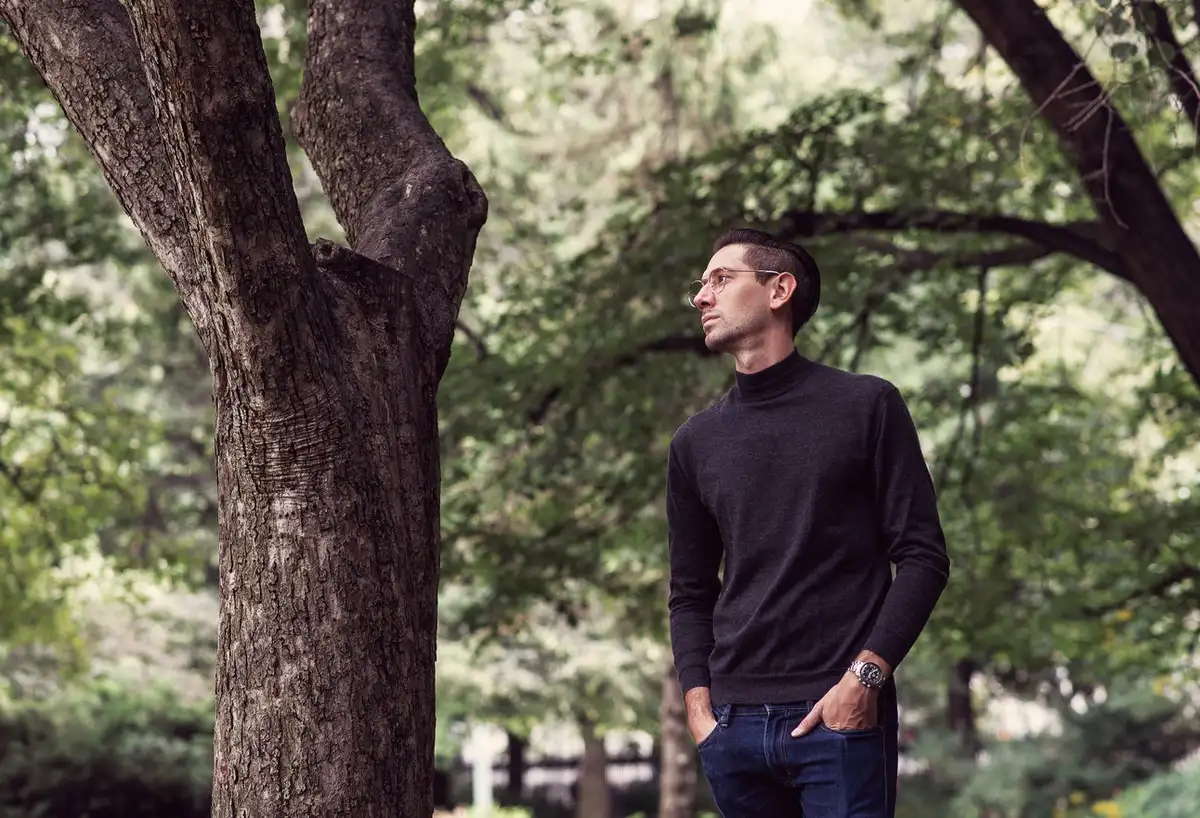
Steve McQueen, Miles Davis, the architects of the 1960s: the turtleneck drags a whole gallery of portraits behind it, which explains its standing. On paper it is a knit with no shirt collar to manage, so the simplest piece in a winter wardrobe. In practice two men out of three buy it in the wrong fibre and shelve it after three wears, defeated by itching and a collar that collapses. Fibre decides everything, ahead of colour and ahead of cut.
Five points, and the rest follows:
- Extra fine merino wool for daily wear, cashmere for maximum comfort.
- No acrylic: it itches, it pills, it holds smells.
- A collar that stands up on its own, never a floppy one.
- Two colours are enough to start: black and heather grey.
- It works alone, under a suit, or under a denim jacket, never with a tie.
Merino, cashmere or cotton: which fibre should you choose?
Extra fine merino wool (around 17 to 19 microns) offers the best value on the market. It regulates temperature, does not scratch against the neck and machine washes at 30 degrees on a wool cycle. Cashmere brings more softness and more warmth for less weight, but a genuine two ply costs 200 euros minimum and wants hand washing. Under 90 euros, a "cashmere jumper" is almost always a 5 % blend, a sales line that delivers nothing. A cashmere turtleneck is therefore for men who already know the shape suits them. To compare prices and fiber content, our ranking of the best cashmere sweaters for men reviews ten brands. Cotton and heavy lambswool give more rustic knits, ideal over jeans, less so under a jacket.
| Fibre | Indicative price | Best for |
|---|---|---|
| Extra fine merino wool | 80 to 180 euros | Daily wear, under a jacket |
| Two ply cashmere | 200 to 450 euros | Comfort and dressed up outfits |
| Wool blend | 50 to 90 euros | A first try on a budget |
| Heavy cotton or lambswool | 60 to 120 euros | Weekends, casual style |
Fitting room test: hold the collar against the inside of your wrist for ten seconds. If it prickles there, it will burn at the neck within an hour.

Which colour and which knit to start with?
Black first, because a black turtleneck goes everywhere, from the office to dinner, and draws that vertical line which slims the torso. Heather grey next, kinder to pale complexions. Then navy, which slides under a blazer without clashing, beige, camel and khaki to lift a winter outfit, and finally burgundy or brown once you own the first three. A fine flat knit dresses up; a cable or ribbed knit stays casual and adds bulk, so avoid it on an already broad frame. If matching holds you back, the full method is in our guide to matching colours in an outfit.
On cut, the knit should follow the chest without clinging: two fingers of ease each side, the hem at fly height, the sleeve at the wrist bone. Too long and it reads as pyjamas; too short and it rides up the moment you raise an arm.
Three ways to wear a men's turtleneck
Under a suit, no tie
Fine black or navy turtleneck, dark suit jacket, matching trousers, leather derbies. The most underrated evening outfit in menswear, and the most comfortable formal one. The rule: fine gauge only, or the collar distorts the jacket lapels. For the classic shirt version, see our guide to choosing a men's suit.
Under a blazer, midweek
Grey turtleneck, navy men's blazer, chinos or wool trousers. The clash of textures does the job a tie used to do, with a tenth of the constraint. A men's cardigan plays the same part in a softer register.
On its own, with raw denim
Black turtleneck, dark jeans, boots or leather sneakers, and a coat or a black leather jacket for men over the top. The simplest look of the three, and the one that rewards a maintained silhouette most, because it hides nothing.

How many turtlenecks does a wardrobe need?
Two are enough in the first year, three if you work in smart clothes: one fine black, one heather grey, one navy. At five wears per jumper per month between November and March, three pieces cover the winter with no emergency washes. Past six, the knitwear sleeps in the drawer and moths do the rest. I keep 4 in my own rotation, and wear 2 of them 80 % of the time.
Care: avoiding pills and a collapsed collar
A wool turtleneck is washed after five to seven wears, at 30 degrees, wool cycle, minimum spin, dried flat. Never on a hanger. The weight of the water stretches the shoulders, permanently. Pills come off with a knit razor or a fabric stone, and stop appearing after a few cycles on good merino. A collar that goes soft in its first season points to a loose knit or missing elastane: that is a manufacturing fault, not a care one, and it cannot be fixed. Store knits folded and stacked by fibre; that is what keeps a collection presentable three winters running.
What does a turtleneck cost per use?
Chosen well, a merino turtleneck costs 120 euros and lasts five years, so 24 euros a season for the piece you will wear most between November and March. That is the best ratio in a winter wardrobe. The refinement a men's turtleneck brings to a dark outfit takes no extra effort, and that is exactly where its elegance sits: the choice of fibre does all the work.
Frequently asked questions
How do you wear a men's turtleneck under a suit?
In a fine gauge only, in a dark colour (black, navy, charcoal), with no tie or shirt underneath. The collar must stay crisp and stand up, otherwise it distorts the jacket lapels.
Does a turtleneck always itch?
No, only when the fibre is too thick or synthetic. Extra fine merino at 17 to 19 microns and cashmere cause no itching for the great majority of men.
Which turtleneck colour should you buy first?
Black, then heather grey. Those two cover the office, going out and the weekend, and match every trouser colour in a man's wardrobe.
Maxime Coste writes about menswear, well-cut basics and dressing well without overspending. He tests, wears and recommends pieces made to last several seasons.